The Ultimate Guide to Five Star Sprint Car Bodies & Kits: Performance, Materials, and Fitment

A sprint car body that fits poorly isn't just a bad look - it's slow. It creates drag, unsettles the chassis, and costs a fortune in repairs every time you tag the wall. Finding the right sprint car bodies is about more than just looks; it's about performance.
Why Custom Sprint Car Bodies Matter
Think of sprint car body components as performance parts, not just a shell. A stock or poorly made body might have gaps, uneven seams, and flimsy materials.
What Sets a Custom Body Apart from Stock
A custom-fit sprint car body is built to tight tolerances. This perfect fit and finish means the body works with the chassis, not against it, giving you a predictable and fast race car.
The Role of Body Design in Sprint Car Performance
A well-designed sprint car body plays a critical role in your aero package. It works in harmony with the wing to create downforce and stability, channeling clean air to the wing while reducing drag down the straights. Poor body shape and fitment can disrupt airflow, causing the car to lose stability, reduce speed, and negatively impact overall performance..
The Science Behind Sprint Car Body Performance
Speed follows sound engineering. Designs grounded in proven principles separate front-runners from the rest.
Aerodynamics 101: How Airflow Shapes Speed
A sprint car wing is essentially an airplane wing turned upside down. It needs clean airflow to perform. The hood, nose, and side panels should condition and guide that air to the wing and engine - reducing drag and maximizing usable downforce.
Weight Distribution & Downforce Explained
Simple physics: reducing mass high on the car lowers the center of gravity, improving rotation through the corner. Rigidity matters, too. A stiff, well-built sprint car body resists unwanted flex so aerodynamic and chassis loads transfer cleanly to the frame and tires, making setup changes more consistent and effective.
How Five Star Tests Their Designs (Wind Tunnel / CFD / Track Data)
The best sprint car bodies aren’t guessed into existence. Designs are refined with Computational Fluid Dynamics (CFD) to model how air moves over and through the car - before a single panel is cut. Those digital results are then validated with real-world track data and, where applicable, wind-tunnel correlation. A disciplined, data-driven process ensures the final body components deliver measurable on-track advantage.
Material Tiers: Good, Better, Best (Standard vs. Pro vs. FR Composites)
Running a 305 on a tight budget? Standard plastic sprint car body kits deliver the durability to handle cushion contact without draining the wallet. Stepping into 410s where every ounce matters? Lightweight sprint car bodies, such as our Pro Composite kits, are engineered to trim critical weight, improving car rotation and response time for faster lap times. Selecting the right material tier aligns body performance with specific racing demands.
| Material Tier |
Best For |
Durability / Repairability |
Weight & Cost |
| Standard Plastic (Good) |
Budget-conscious teams, weekly racing |
High-impact resistance, very durable, easily repaired |
Standard weight, lowest cost |
| Pro Composite (Better) |
Competitive teams seeking a weight advantage |
Lighter than plastic, rigid, repairable |
Lightweight, mid-range cost |
| Carbon Fiber (Best) |
Elite teams, maximum weight savings |
Extremely light, very high rigidity |
Lightest weight, highest cost |
| FR Composites |
Cockpit/Tail heat zones, high-risk areas |
Flame-retardant, high-temp resistant |
Specialty use, critical for safety |
Select the material tier that fits the program by balancing durability, weight, and cost - ranging from budget-smart Standard plastic to lightweight Pro Composite.
Precision Fitment: How Five Star Achieves a Perfect Fit
Fitment is everything. Precision fitment keeps aero clean, balance stable, and performance repeatable.
Measuring for Your Chassis
A proper sprint car body starts with a straight chassis. Before ordering, measure the frame precisely. Five Star sprint car bodies are built to extremely tight tolerances, so accurate measurements are critical. With a straight frame, panels bolt on square - exactly as designed.
Universal Fitment (Maxim, Triple X, Schnee-Lawson & J&J)
Engineered for universal fit on the most common chassis - Maxim, Triple X, Schnee-Lawson, and J&J - to reduce fabrication time and deliver a clean, professional install from the start.
CNC-Cut Panels and Digital Templates
Every component is produced with high-precision CNC cutting and digital templates for consistency. Replacement body panels fit like the first - no surprises. Built in the U.S. for quality you can count on.
Sprint Car Body Kits: Panels, Options & Customization
Understanding the sprint car body’s anatomy leads to smarter choices and measurable performance gains.
Complete Kit Overview (Side Panels, Noses, Hoods)
A complete kit covers the core components. Noses use reinforced structures to handle push-offs without folding or cracking. Hoods are profiled to clear the air box and injectors while maintaining a clean airstream to the driver and engine intake. Side panels are engineered for rigidity to manage airflow the length of the car, build side-force, and feed clean air to the wing.
Finishes and Custom Paint Options
Kits are offered in standard molded finishes, commonly white or black, ready for graphics. Surfaces are also prepared to be paint-ready or to accept custom vinyl wraps, simplifying sponsor branding and number application.
Replacement Panels & Modular Designs
Contact with the wall is part of racing. Modular construction means replacing only the damaged panels, not entire sections. The result: quicker turnaround, controlled costs, and a consistent fit when it’s time to get back on track.
Inside Our Fabrication Process
Trust is built through transparency. This is how quality sprint car bodies are made.
From CAD Design to CNC Cutting
A digital-tooled workflow turns CAD intent into tight-tolerance, repeatable sprint car body components.
- DFM & CAD setup: Convert program specs into 3D CAD and run design-for-manufacture checks to align geometry with forming and machining.
- Tooling & templates: Build in-house tooling and digital templates to lock interfaces, hole patterns, and clearances.
- Forming method selection: Match each part to drape or vacuum forming to balance optical quality, strength, and repeatability.
- CNC trim & identification: Program multi-axis CNC for edges and holes, then apply part IDs for interchangeability and fast reorders.
- Coatings & printing (as specified): Apply abrasion-resistant, UV-stable coating and screen-print frits or masks where required.
A vertically integrated CAD→tooling→forming→CNC→coating pipeline delivers consistent, bolt-on fit and finish at production scale.
Assembly & Quality Control
From there, expert fabricators take over. Integrated assembly and certified quality controls ensure every kit meets racing demands.
- Kitting & surface prep: Group panels, hardware, and accessories into application-specific kits and protect coated surfaces.
- Dimensional verification: Check hole patterns, edge profiles, and critical dimensions against CAD and digital templates.
- Quality system: Run ISO 9001 processes with documented work instructions and continuous improvement.
- On-site testing: Validate impact, abrasion, chemical resistance, and UV/weathering to relevant standards.
- Documentation & traceability: Maintain materials, coatings, and test records, and mark parts for accurate reorders.
ISO-driven workflows, in-house testing, and full traceability produce race-ready kits with predictable fit and durability. 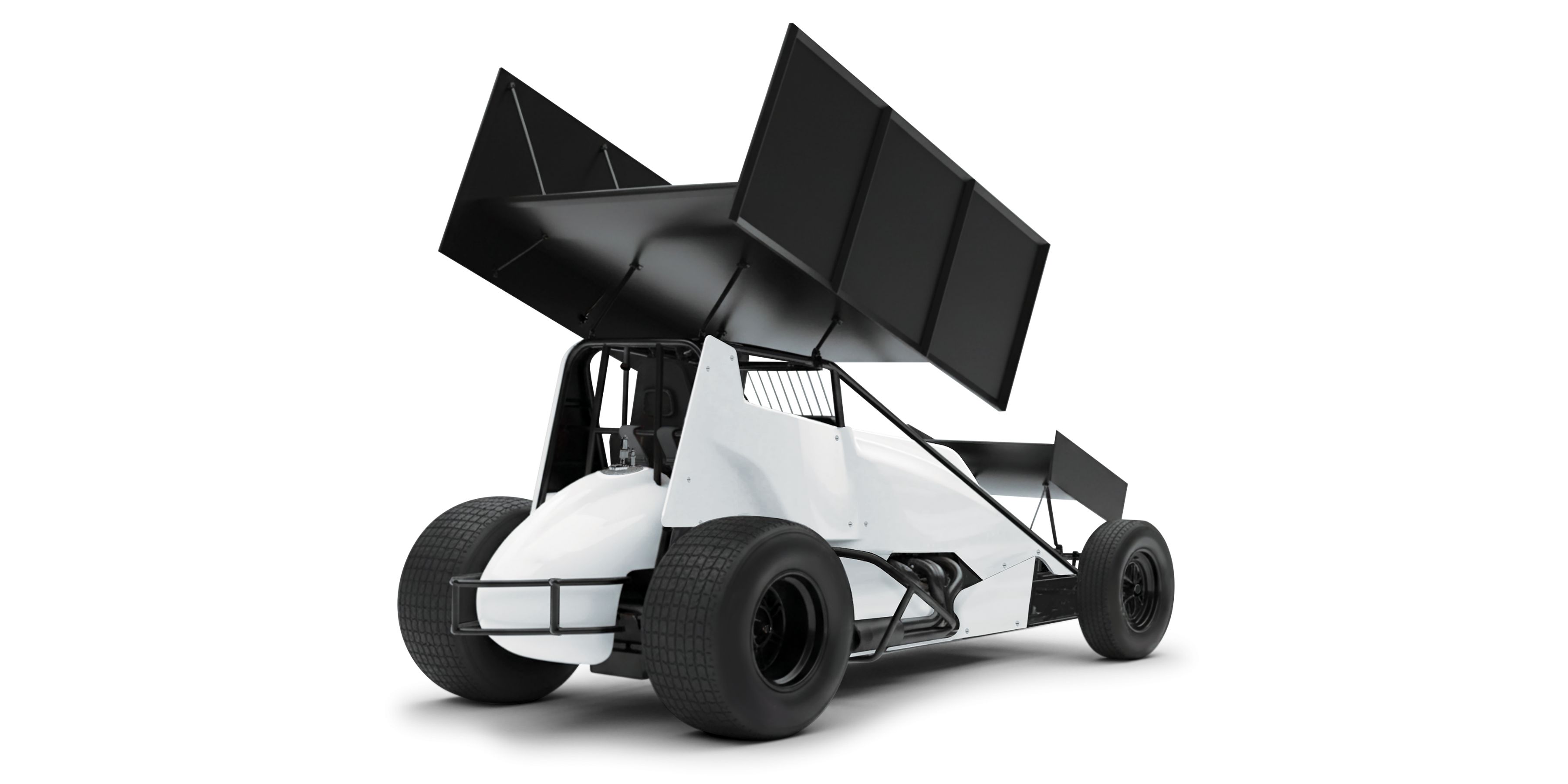
Maintenance & Longevity Tips
A little care goes a long way in making your sprint car body last.
Cleaning, Storage & Repair
Keep panels clean to spot issues early. Use mild soap and water with a soft cloth; avoid ammonia, solvents, or abrasive cleaners on composites and polycarbonate. Store bodywork out of direct sun and heat, with edges protected to prevent warping. Minor damage can often be plastic-welded or patched to get through race night; schedule a proper repair or replacement when back in the shop.
Replacement Cycle & Material Care
Know when a panel is “raced out.” Repeated impacts reduce rigidity and predictability. Inspect frequently for stress whitening in plastics, delamination in composites, elongation around mounting holes, and cracks near fasteners or bends. Replace suspect parts before they compromise fit, aero balance, or safety.
How to Order Your Custom Sprint Car Body
Getting the right sprint car body for your program is a straightforward process.
Requesting a Quote
Provide chassis model, class (305/360/410), and material tier (Standard, Pro Composite, FR where needed). Include finish preference and any unique fitment notes. A detailed quote is issued to match the specification.
What to Expect in the Build Process
Lead times vary with seasonality; current timing is included with the quote. All dimensions, materials, and options are confirmed prior to fabrication, ensuring the finished body arrives with the intended fit, finish, and performance.
Get a Custom Quote →
Frequently Asked Questions
Pricing depends on material tier - Standard, Pro, or
Carbon - and any custom options. Standard kits are the most budget-friendly; Pro and Carbon tiers prioritize weight savings at a higher price point. For exact numbers, request a tailored quote.
Lead times vary by season. Off-season ordering typically yields the quickest timelines. Current lead time is provided with the quote and confirmed before
fabrication.
Yes. Every
sprint car body panel is available individually. The modular design allows replacement of a single damaged panel instead of an entire section.
In most cases, yes. Core dimensions across these classes are nearly identical, and Five Star Sprint Car bodies are engineered for universal fitment on major chassis platforms (e.g., Maxim, Triple X, Schnee-Lawson, J&J). Whether you're racing in a 305, 360, or 410 class, our sprint car bodies provide a custom fit that ensures top performance across various racing formats.
The Five Star Advantage
Sprint Car Bodies that fit right, perform right, and last. U.S.-built quality, race-proven engineering, precise fitment, and responsive support - no excuses, just reliable performance.
Get a Custom Quote →